Optimizations
When running code in Eager Mode, PyTorch and Jax see function calls one at a time. They cannot reason holistically about how these functions interact together. So while each individual function is written optimally, the transitions between functions are suboptimal.
On the contrary, jax.jit and torch.compile allow their compilers to see the whole code ahead of time. This gives them the opportunity to fuse, rewrite, and eliminate code optimally.
Kernel Fusions
Let's take another look at the code from the previous chapter.
def complex_activation(x, y):
    # Eager PyTorch launches 6 separate kernels for this:
    # Read/Write memory 6 times!
    a = torch.sin(x)
    b = torch.cos(y)
    c = a * b
    d = c + x
    e = d * y
    return torch.relu(e)

opt_activation = torch.compile(complex_activation)
In Eager Mode, we scheduled 6 different kernels one after the other. This means that the GPU had to load from HBM the whole array each time and then write it back in between kernels.
When we compile the code, PyTorch fuses all the kernels, allowing the GPU to load the arrays x and y from HBM once, and applying all the computations once from fast memory.
Here's the flame graph
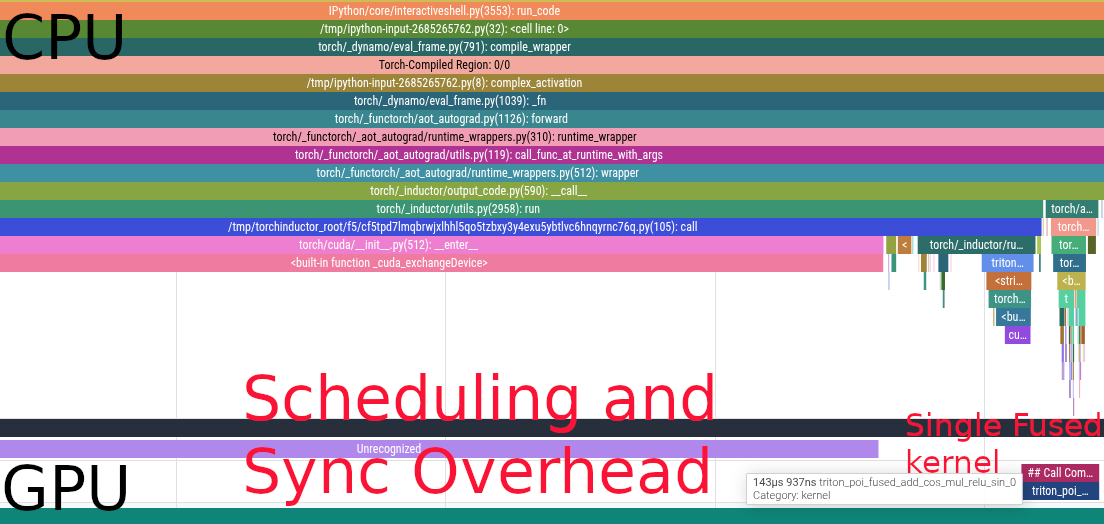
We now have a single kernel instead of 6. Bringing the latency down from \(731\mu s\) to \(144\mu s\).
Buffer Reuse
When an array is read once and not needed after, ML compilers can reuse the memory space instead of constantly reallocating. This saves both memory and latency by increasing cache locality.
In the previous example, compilers need to allocate for x and y. Then
- We have to allocate
aandbbecausexandyare needed later a(orb) can be overwritten withcbecause they are not reusedxcan be overwritten withdycan be overwrittenewhich can be muttated in place before returning
Relayout
ML compilers are able to reason about the best layout for your operations. For instance, the MXU on the TPU operates on array of shape \((8, 128)\) at least. If you have an einsum with an input shape \((64, 4, 1024)\), the 4 being a non contracted batch dimension like the number of heads in attention, jax.jit will transpose your array to \((4, 64, 1024)\) under the hood, making full use of the MXU.
Dead Code Elimination
Sometimes, we write code that is not needed for anything. It is not returned, nor does it have any effects (like print). This code is completely safe to be removed from the program.
For instance, in this example the x @ gating1 call is absent from the flame graph
def mlp(x, gating0, gating1, linear):
    y = x @ gating0
    # x @ gating1 is never accessed, this computation is useless
    # it is eliminated by the compiler
    unused = x @ gating1

    y = torch.nn.functional.relu(y)
    out = y @ linear
    return out

compiled_mlp = torch.compile(mlp)

device = torch.device("cuda")


generator = torch.Generator(device=device).manual_seed(0)

b = 512
d = 2048
f = 2 * d

x = torch.randn((b, d), generator=generator, device=device, dtype=torch.bfloat16)
gating0 = torch.randn((d, f), generator=generator, device=device, dtype=torch.bfloat16)
gating1 = torch.randn((d, f), generator=generator, device=device, dtype=torch.bfloat16)
linear = torch.randn((f, d), generator=generator, device=device, dtype=torch.bfloat16)

There are only 2 gemm kernel calls