Eager Mode
We need to first understand Eager Mode to understand how compilation improves perfomance on top of it.
Eager Mode is the standard execution model of Jax and PyTorch. When you run ML code without torch.compile or jax.jit, you are executing code on the CPU in the Python runtime, this code sends instructions to the GPU or TPU that actually performs the computations.
When you chain multiple operations one after the other, the CPU doesn't wait for the GPU/TPU to complete its task, it takes the next operation and already schedule it concurrently to the GPU/TPU's execution. When all operations have been scheduled, the CPU waits for the GPU/TPU's work to be over.
Let's have a look at this PyTorch function running on GPU.
import torch
from torch.profiler import profile, record_function, ProfilerActivity

def complex_activation(x, y):
    # Eager PyTorch launches 6 separate kernels for this:
    # Read/Write memory 6 times!
    a = torch.sin(x)
    b = torch.cos(y)
    c = a * b
    d = c + x
    e = d * y
    return torch.relu(e)
The Bottleneck: In Eager Mode, every line of code above requires reading data from the GPU's memory (HBM), computing, and writing the result back. We are constantly moving data back and forth, which is often slower than the math itself.
We profile it using the torch profiler
N = 20 * 1024 * 1024
x = torch.randn(N, device='cuda')
y = torch.randn(N, device='cuda')

torch.cuda.synchronize()
# Warmup
complex_activation(x, y)
torch.cuda.synchronize()

with profile(
    activities=[ProfilerActivity.CPU, ProfilerActivity.CUDA],
    record_shapes=True,
    with_stack=True
) as prof:
    with record_function(f"run"):
      complex_activation(x, y)
    torch.cuda.synchronize()
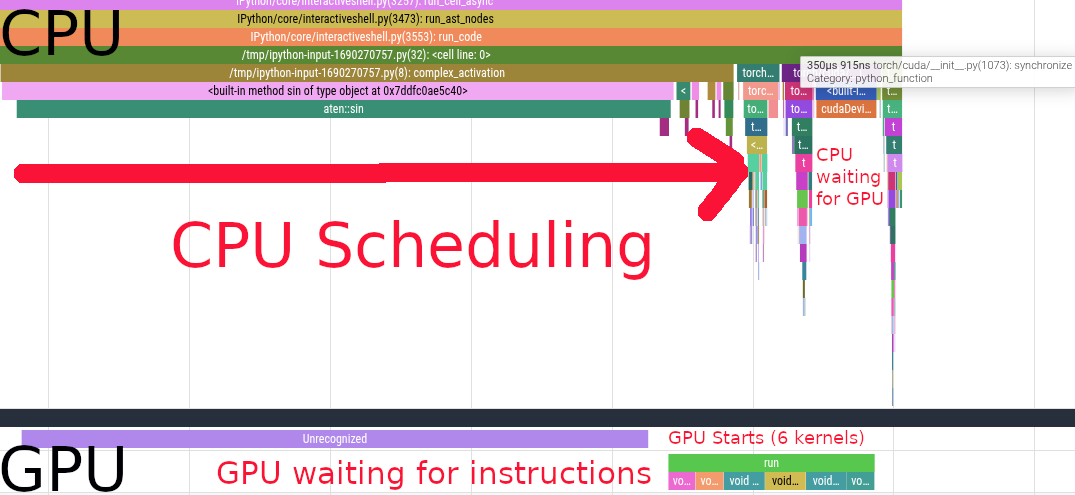
We see the CPU scheduling the first sin call. Scheduling the first kernel is very slow because of the synchronization overhead. After that, we see a bunch of other kernels being scheduled on the CPU side, those are cos, a * b, c + x, d * y and relu.
We see that the GPU starts working while the CPU is still scheduling instructions. After scheduling, the CPU starts waiting for the GPU to complete its work. The GPU executes 6 different kernels in \(731\mu s\).