ML Compilers
Python is a particularly inefficient programming language. Yet, it is used almost ubiquitously to develop massive models and deploy them efficiently at scale. How come?
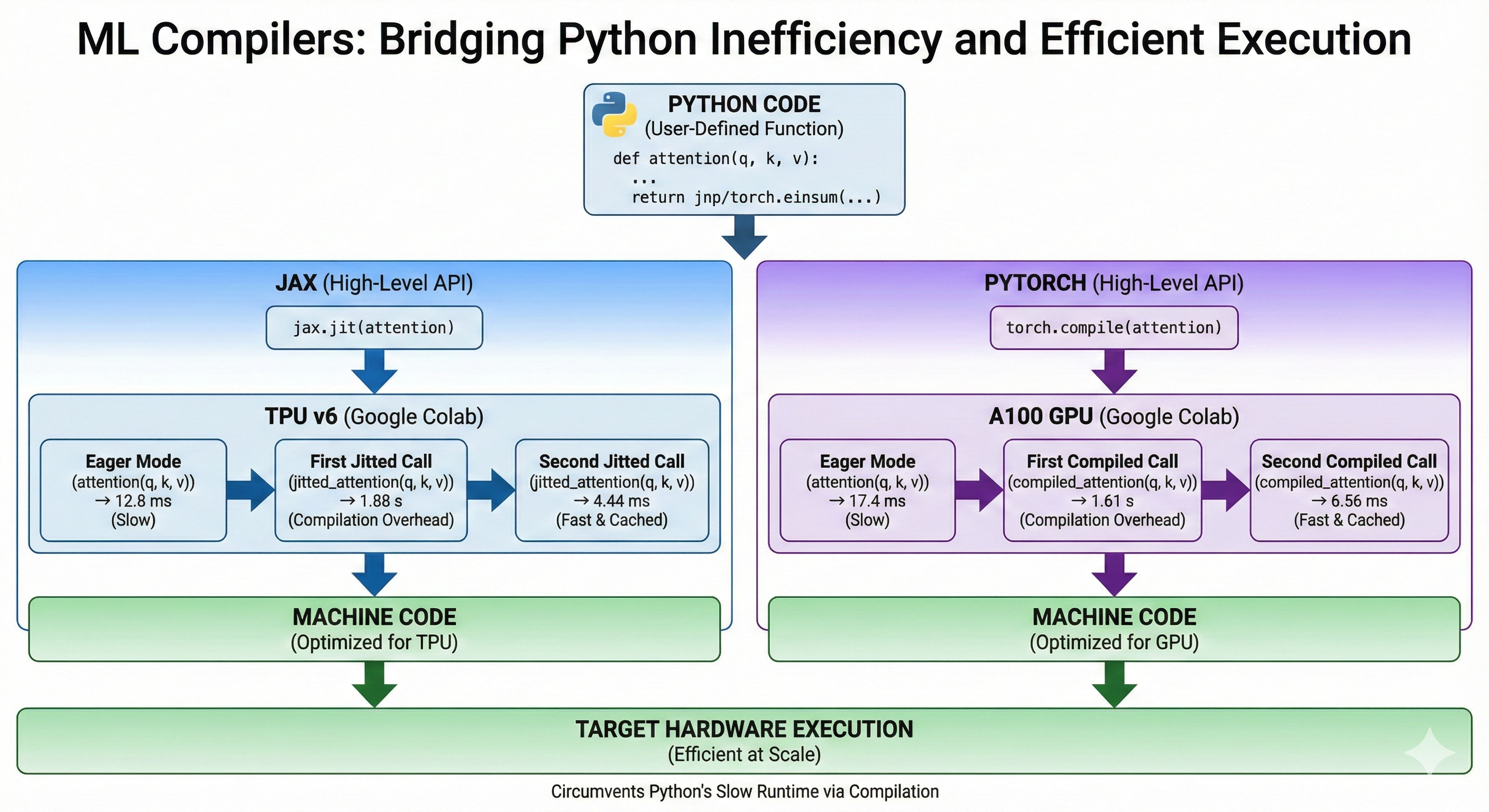
ML frameworks circumvent Python's slow runtime by compiling the model's code into machine code for the target architecture just like the Rust compiler would. This allows us to write efficient code despite python.
High Level APIs
In this chapter, we will cover both Jax and PyTorch. They both provide an API to compile a Python function and make it more efficient. For now, we will only showcase the APIs. It the later subchapters, we will dive into the differences between Jax and PyTorch compilation processes and the different optimizations that the ML compilers perform.
Let's implement the attention mechanism in both Jax and PyTorch to demonstrate how the API works at a high level.
Jax
Jax offers the jax.jit method that takes a python function and a set of abstract inputs and compiles an optimized method for the function, inputs pair. Abstract inputs are composed of a dtype and a shape. The first call to the jitted function is slow because it needs to perform the compilation, the subsequent calls are very fast because the compilation is cached. Calling the same method with inputs of different dtype or shape will trigger a recompilation.
We are running this on a TPU v6 in Google Colab. We use block_until_ready otherwise, Jax would not wait for the computations to be complete on TPU before yielding back control to the CPU.
from jax import numpy as jnp
import jax

def attention(q, k, v):
  qk = jnp.einsum('btnh,bsnh->btns', q, k)
  scores = jax.nn.softmax(qk, axis=-1)
  return jnp.einsum('btns,bsnh->btnh', scores, v)

jitted_attention = jax.jit(attention)
Weights initialization
key_q, key_k, key_v = jax.random.split(jax.random.PRNGKey(0), 3)

shape = (32, 1024, 16, 256)

# Automatically on TPU in Jax
q = jax.random.normal(key_q, shape, dtype=jnp.bfloat16)
k = jax.random.normal(key_k, shape, dtype=jnp.bfloat16)
v = jax.random.normal(key_v, shape, dtype=jnp.bfloat16)
Runtime in Eager Mode
%%time
out = attention(q, k, v).block_until_ready()
stdout
Wall time: 12.8 ms
First jitted call
%%time
out = jitted_attention(q, k, v).block_until_ready()
stdout
Wall time: 1.88 s
Second jitted call
stdout
Wall time: 4.44 ms
PyTorch
PyTorch uses the torch.compile method. At a high level, it is very similar to jax.jit. Notice how similar the code is.
We are running this on an A100 in Google Colab.
import torch

def attention(q, k, v):
  qk = torch.einsum('btnh,bsnh->btns', q, k)
  scores = torch.nn.functional.softmax(qk, dim=-1)
  return torch.einsum('btns,bsnh->btnh', scores, v)

compiled_attention = torch.compile(attention)
Weights Initialization
# Explicitly set default device to GPU
device = torch.device("cuda")

shape = (32, 1024, 16, 256)

generator = torch.Generator(device=device).manual_seed(0)

q = torch.randn(shape, generator=generator, device=device, dtype=torch.bfloat16)
k = torch.randn(shape, generator=generator, device=device, dtype=torch.bfloat16)
v = torch.randn(shape, generator=generator, device=device, dtype=torch.bfloat16)
Runtime Eager Mode
%%time
out = attention(q, k, v)
# Equivalent of block_until_ready
torch.cuda.synchronize()
stdout
Wall time: 17.4 ms
First Compiled Call
%%time
out = compiled_attention(q, k, v)
# Equivalent of block_until_ready
torch.cuda.synchronize()
stdout
Wall time: 1.61 s
Second Compiled Call
stdout
Wall time: 6.56 ms
Why not just use another language?
There are efforts to create new languages for ML. For instance Julia which seems to have lost its momentum and Chris Lattner's Mojo which is too recent to tell.
The reasons Python is so commonly used in the ML community are mostly historical and cultural. The language has been around for more than 30 years, so it has a lot of mature and stable libraries that are commonly taught in universities. It is also easy to pick up and play with, making it ideal for quick iterations in research environments. At this point, Python's adoption is not about its inherent qualities but mostly about network effects, which are extremely difficult to compete against.