Jax vs PyTorch
While Jax's and PyTorch's APIs look similar, they handle compilation very differently. This matters a lot when writing code in either library and when thinking about performance.
Tracing (Jax)
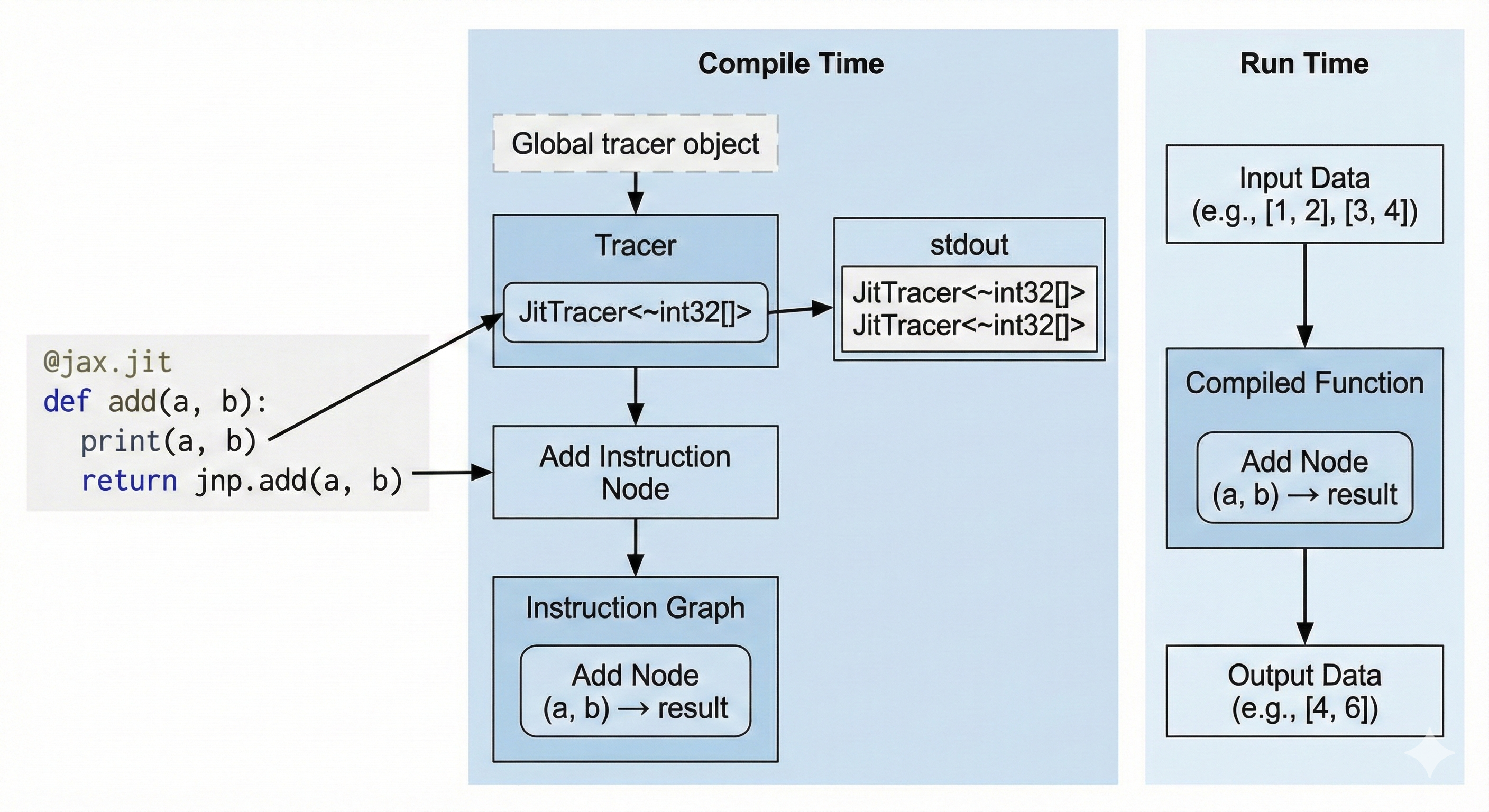
Jax uses the tracing approach. When we we compile a Python method using jax.jit, we set a global variable called the Tracer. When our Python code encounters a Jax method, it appends an instruction to the global Tracer. At the end of our function, the Tracer has a full graph of instructions that it finally compiles.
This means that:
- The only code that will be compiled will be the
Jaxmethods we encountered during compilation. If..elsestatements andfor loopsare only evaluated at compile time and their evaluation will be constant at run time.- Runtime dependent control flow has to be implemeted using
JaxAPIs likejax.lax.condandjax.lax.fori_loop.
Another particularity is that jax.jit will compile your method for a specific set of input shapes and dtypes. Changing your input shape will force a recompilation of the program.
Furthermore, jitted methods are purely functional. We cannot mutate a value in-place. Performance Note: Although the API is functional (create new arrays), the compiler optimizes this into in-place updates under the hood, so you don't lose performance.
Let's illustrate what this means:
Printing (Jax)
import jax

@jax.jit
def add(a, b):
    print(a, b)
    return a + b

add(1, 2)
add(3, 4)
stdout
JitTracer<~int32[]> JitTracer<~int32[]>
The print statement is not a Jax method, so it only prints at compile time. We only have one stdout line even though we called the method twice because it only printed during compilation and the second call is cached. If we wanted to print actual runtime values, we would use jax.debug.print.
Runtime If Statement (Jax)
import jax

@jax.jit
def conditional(a, b):
    if a > b:
        return a
    return jnp.exp(b)

conditional(3, 4)
stderr
TracerBoolConversionError:
    Attempted boolean conversion of traced array with shape bool[].
We attempted to use a runtime value in an if statement, resulting in a compile-time error. We can fix this using jax.lax.cond to ensure that the Tracer knows about the if statement and compiles it.
import jax
import jax.numpy as jnp

@jax.jit
def conditional(a, b):
    return jax.lax.cond(a > b, lambda: a, lambda: jnp.exp(b))

# (Using floats because a and exp(b) must have the same type)
conditional(1., 2.)
Static Arguments
We can define static arguments to be passed to the method. These arguments will not be traced, however they can be used for control flow during compilation.
Let's look at this code:
from functools import partial
import jax
import jax.numpy as jnp

@partial(jax.jit, static_argnames=('add_residuals',))
def linear_layer(x, w0, add_residuals: bool = False):
    y = x @ w0
    # add_residuals is static so it can be used in the `if` statement
    if add_residuals:
        return x + y
    return y

x = jnp.ones((32, 128))
w0 = jnp.ones((128, 128))
When we compile the method with add_residuals = False, the Tracer never sees the x + y operation, so it never gets compiled and the Tracer never knows this line of code existed. If you call the function again with add_residuals = True, Jax MUST recompile the whole function.
We can even pass functions or complex objects as static arguments!
from typing import Callable

@partial(jax.jit, static_argnames=('activation',))
def linear_layer(x, w0, activation: Callable[[jax.Array], jax.Array] | None = None):
    y = x @ w0
    if activation:
        return activation(y)
    return y

x = jnp.ones((32, 128))
w0 = jnp.ones((128, 128))

linear_layer(x, w0, jax.nn.relu)
Bytecode Interception (PyTorch)
PyTorch's approach puts less weight on the developer. Any method that works in eager mode will also work with torch.compile. This is achieved by intercepting Python's bytecode and dynamically modifying it right before execution. This throws all of Jax's limitations out of the window.
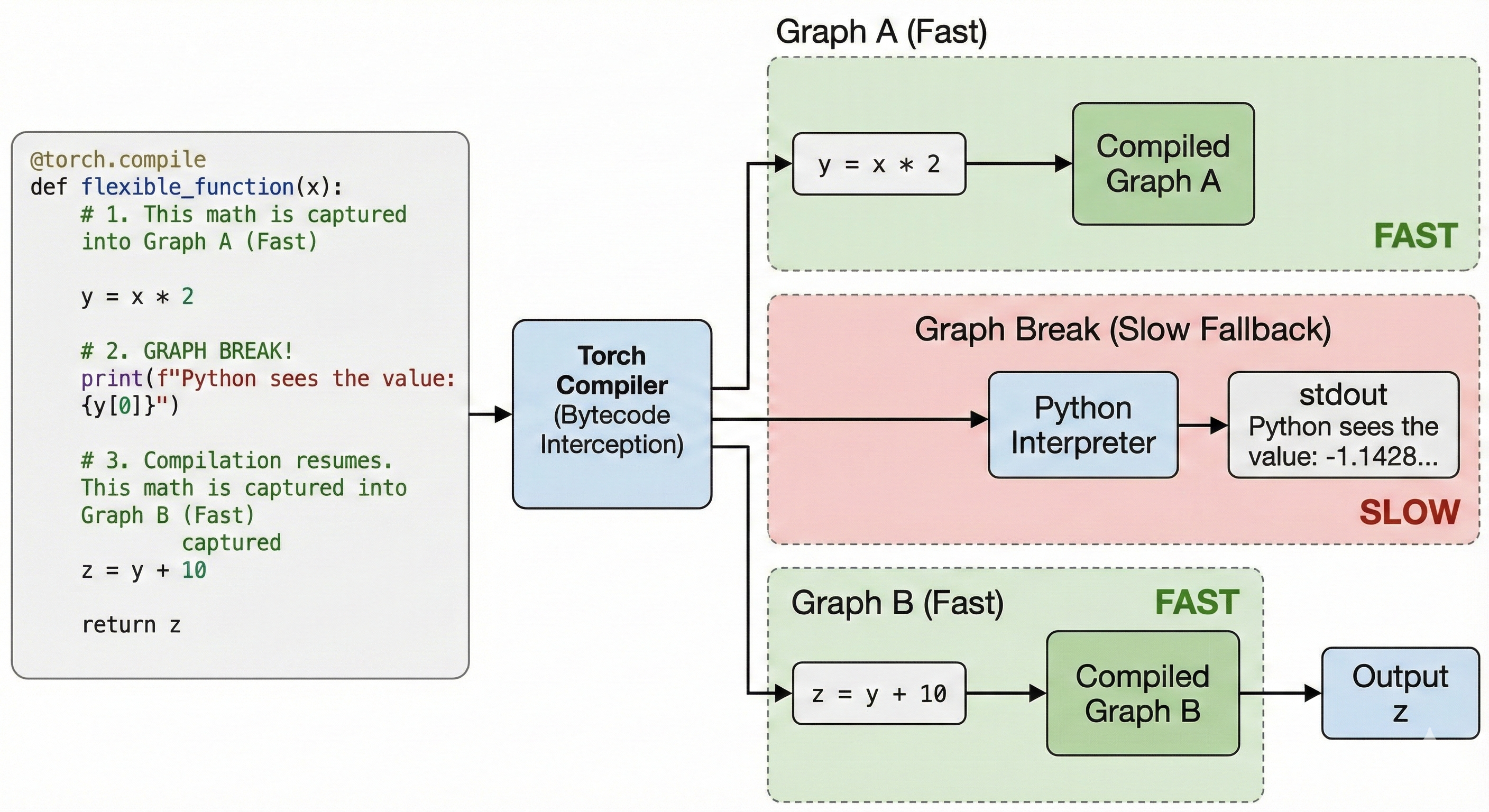
Some Python operations cannot be compiled directly by torch.compile. For instance print or numpy calls. When torch.compile encounters these operations, it falls back to Python; we call this a Graph Break. Graph Breaks are slow and should be kept to a minimum to reach maximum performance.
Printing (PyTorch)
import torch

@torch.compile
def flexible_function(x):
    # 1. This math is captured into Graph A (Fast)
    y = x * 2

    # 2. GRAPH BREAK!
    # The compiler pauses. Python executes this print.
    print(f"Python sees the value: {y[0]}")

    # 3. Compilation resumes. This math is captured into Graph B (Fast)
    z = y + 10
    return z

x = torch.randn(5)
flexible_function(x)
stdout
Python sees the value: -1.1428250074386597
We print the runtime value at the cost of a graph break.
Runtime If Statement (PyTorch)
import torch

@torch.compile
def conditional(a, b):
    if a.sum() > b.sum():
        return a
    return torch.exp(b)

a = torch.randn(5)
b = torch.randn(5)

conditional(a, b)
This code compiles without errors unlike Jax. However, it introduces a Graph Break. We can fix it by staying in graph with an API like torch.where.